About
My research sits at the intersection of ancient-ocean chemistry, isotope geochemistry, and paleoclimatology. I reconstruct how the chemistry of Earth's oceans has changed over the past several hundred million years, and what those changes reveal about the tectonic and climatic processes that controlled them.
Read more
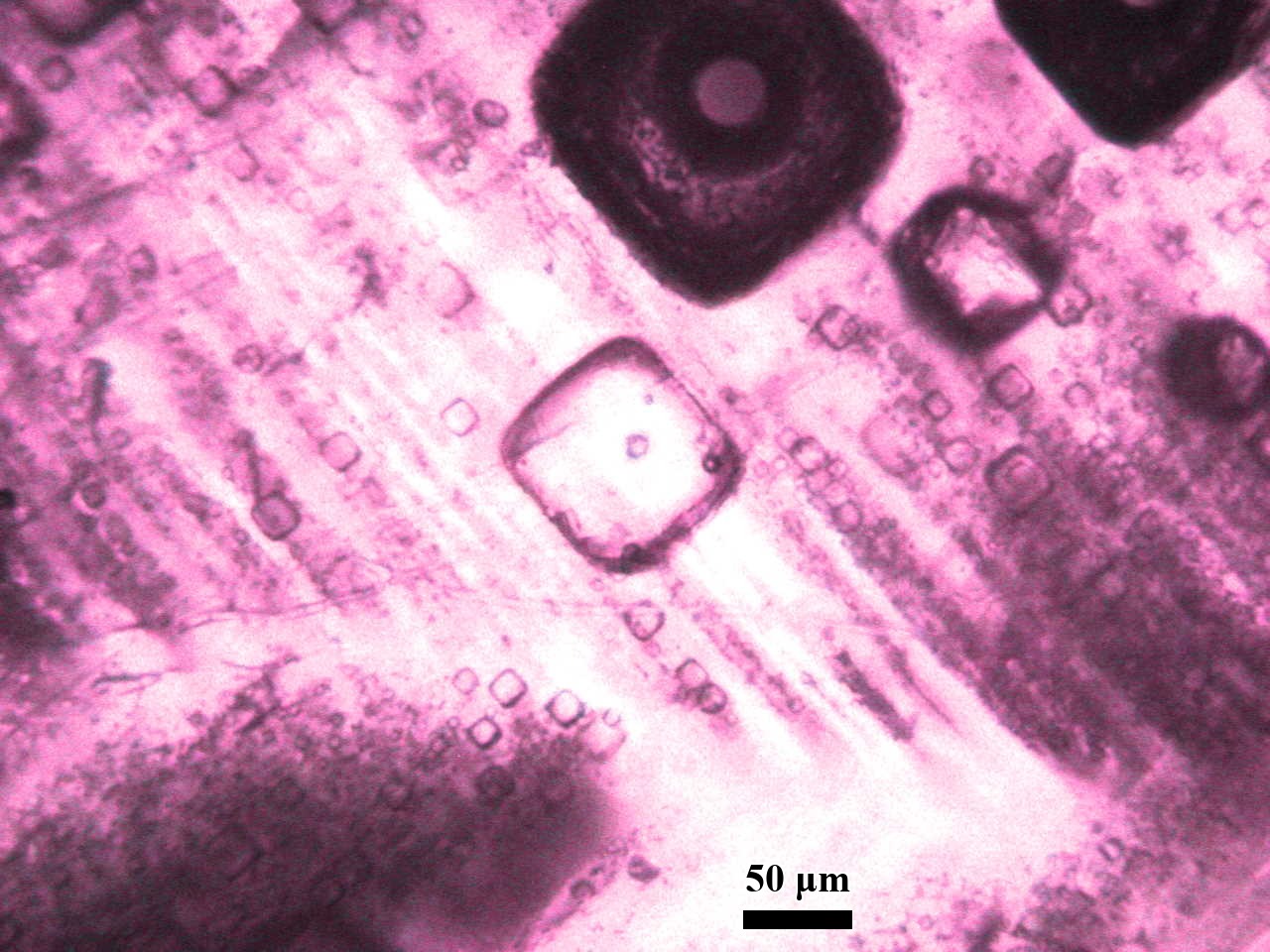
Fluid inclusions in marine halite are micrometer-scale droplets of evaporated seawater sealed inside the salt as it grew, and they preserve the most direct record of ancient ocean chemistry available. Reading them means measuring picoliter volumes, so I developed a combined LA-ICP-MS and cryo-SEM-EDS technique that resolves major, minor, and trace elements in single inclusions down to 1 ppb. Applying it to more than 1,300 inclusions from ~30 evaporite basins, I built records of seawater Mg/Ca, Ca²⁺, Sr²⁺, Li⁺, SO₄²⁻, and δ⁷Li across the past 550 million years. These records track major transitions in the Earth system, including aragonite versus calcite seas and greenhouse-icehouse oscillations, and, with mass-balance modeling, they identify plate tectonics and continental weathering as first-order controls on seawater chemistry and atmospheric CO₂.
Beyond the Phanerozoic, I am extending δ⁷Li records deeper in time using marine dolostones, analyzed by an improved bulk dissolution technique, clean-lab column chemistry, and solution ICP-QQQ-MS at sub-nanogram levels. Working from more than 500 dolostones, I am reconstructing the lithium isotope record of seawater back toward 3 billion years and investigating which carbonate archives faithfully preserve a seawater signal. That would give δ⁷Li records across the Proterozoic and Archean, where preserved marine evaporites are rare or absent.
A record of how seawater composition changed through time also carries an applied implication. Paleozoic and Mesozoic seawater held 5 to 15 times more lithium than the modern ocean, and the basinal brines that have emerged as a major lithium resource and are now targeted for production sit in strata deposited during exactly those intervals. I am testing whether such brines inherited their enrichment from ancient seawater or were later modified by brine-rock interaction, hydrothermal input, and weathering. The distinction determines whether prospective basins should be sought by stratigraphic age or by basin history, and it extends to boron, potassium, magnesium, bromine, and rare earth elements as well. This work draws on a combination of field and laboratory research at more than twenty-five lithium prospects across the western United States and Canada.
Supported by an NSF Office of Polar Programs Postdoctoral Fellowship and in partnership with the NSF Center for Oldest Ice Exploration (COLDEX), I am developing an in-situ approach using cryo-cell LA-ICP-MS to chemically image and date the oldest ice on Earth, with the goal of recovering a direct atmospheric sample from the mid-Pliocene, the most recent time atmospheric CO₂ was near today's levels.
Path
I trained first in Eritrea, where I earned my BSc in geology in 2011 at the Eritrea Institute of Technology with a thesis combining field mapping, geochemistry, and detailed logging of two deep sedimentary cores to reconstruct the Pleistocene evaporite succession of the Colluli area, in the Danakil Depression, one of the hottest and most tectonically active evaporite basins on Earth. Following my graduation, I was hired as a teaching assistant and lecturer for four years, teaching general geology, geological map interpretation, mineralogy, geophysics, and field mapping, and worked on GPS geodetic and seismic surveys of the Afar Rift with collaborators from MIT and Bristol. I completed my PhD at Binghamton University with Tim Lowenstein, reconstructing the major, minor, and trace element composition of Phanerozoic and Neoproterozoic seawater from fluid inclusions in marine halite. I came to Princeton in 2022 as a Harry H. Hess Postdoctoral Fellow, held an NSF Office of Polar Programs Postdoctoral Fellowship from 2024 to 2026, and now hold a Gordon and Betty Moore Foundation Postdoctoral Fellowship, working with John Higgins and Elizabeth Niespolo.
Field, laboratory, and modeling
I have mapped evaporites in the Danakil Depression, studied modern halite deposition along the Dead Sea shoreline and in shallow sediment cores, and explored lithium-bearing basins at more than twenty-five sites across six western U.S. states. I have developed analytical methods and operated LA-ICP-MS, cryo-cell LA-ICP-MS, and clean-lab column chemistry with solution ICP-QQQ-MS. I also build mass-balance and box models that use coupled elemental and isotope records of seawater to estimate global fluxes, including riverine input, seafloor hydrothermal circulation, low-temperature crustal alteration, and uptake into marine clays, and to quantify the relative contributions of tectonics, volcanism, and continental weathering.
Teaching and mentoring
I have taught geochemistry, paleoclimate, and undergraduate Earth science courses at Binghamton University as a teaching assistant for five years, lectured at the Eritrea Institute of Technology for four years, and led eight undergraduate field camps for more than 100 students. I have supervised more than 40 undergraduate theses and field projects there, and trained graduate students, a postdoctoral researcher, and a laboratory manager at Binghamton and Princeton in the analytical methods I developed there. Many of the students I taught in Eritrea now work at the Geological Survey of Eritrea or in the mining industry, and others have completed graduate degrees in Europe and North America.
Research Program
Quantitative, micrometer-scale chemistry of the archives that record Earth's surface environment. See research overview →
Ancient oceans
Seawater through deep time
550 Ma of major, minor, trace-element, and lithium-isotope seawater chemistry from fluid inclusions in halite.
Ancient oceans
Dolostones and seawater lithium isotopes
A lithium isotope record of seawater back toward 3 billion years from marine dolostones.
Basinal brines
Critical minerals in brines
Lithium and other critical minerals in sedimentary brines, and their links to ancient seawater chemistry.
Polar ice
Antarctic ice geochemistry and geochronology
High-resolution impurity mapping, and an ⁸⁷Sr/⁸⁶Sr chronometer for dating folded, >1-Ma-old blue ice via cryo-cell LA-ICP-MS.